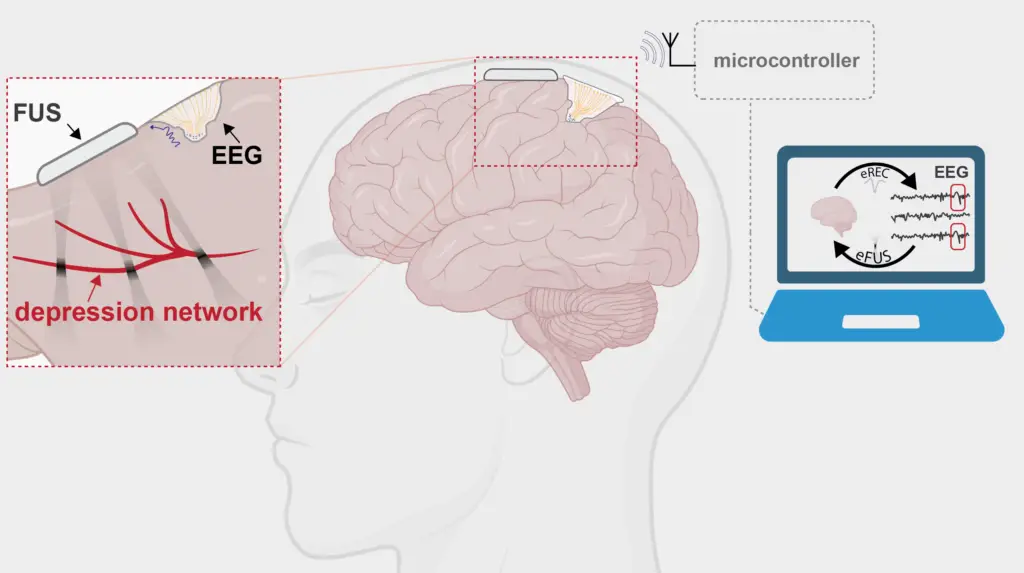
UPSIDE aims to research a minimally-invasive personalized therapy for Major Depressive Disorder by means of focused ultrasound. Major depressive disorder (MDD) is the leading cause of disability worldwide, affecting 300 million people with a lifetime prevalence of 15%. Furthermore, approximately one third of all MDD patients fail to respond to currently established treatments based on medication and psychotherapy, thus falling into the category of Treatment-Resistant Depression (TRD) patients.
Our objective is to research and validate in vivo a hybrid neurotechnology consisting of an epidural focused ultrasound (eFUS) stimulator employing three-dimensional beamforming, and a high-density epidural EEG recording system. Epidural deployment of these devices will be enabled by novel methods for massive integration and miniaturization of high-performing piezoelectric ultrasound materials and high-fidelity organic bioelectronic materials with high energy-efficient complementary metal-oxide semiconductor (CMOS) technology in a biocompatible manner.
The UPSIDE project will result in a demonstrator which will allow, for the first time, network stimulation and simultaneous biomarker readout in behavioral experiments with animal models featuring depression-like symptoms. This technological breakthrough will pave the way towards a personalized treatment for TRD.
Electroconvulsive therapy (ECT), repetitive Transcranial Magnetic Stimulation (tRMS), Vagus nerve stimulation, deep brain stimulation (DBS) and transcranial focused ultrasound (tFUS) still show poor spatial resolution (ECT, tRMS, tFUS) or low network coverage (VNS, DBS), with average remission rates in clinical trials still lower than 30%. Apart from the existing stimulation hurdles, reliable biomarkers for depression are needed as a diagnostic tool, and, in the case of neuromodulation therapies, to determine the stimulation efficacy and allow for personalized treatment.
Partners
0
Work Packages
0
Years
0
To subscribe to our Newsletter & receive our latest news